


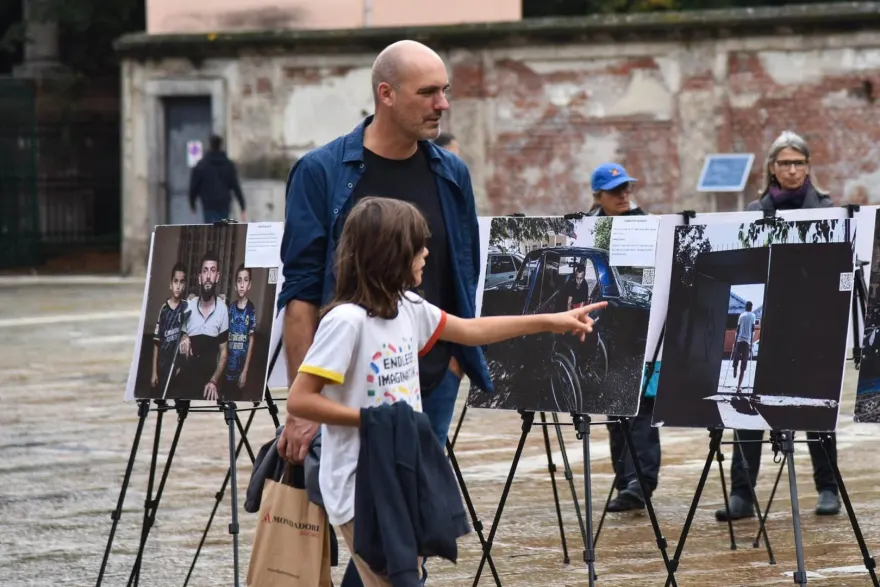
BAKU, Azerbaijan, October 22. As part of the international “World Without Mines” campaign, organized in Europe at the initiative of Azerbaijan’s “Gilavar Photo Club” Public Association, another exhibition was held on October 17 in Milan, Italy.
This was reported by Agency for State Support to Non-Governmental Organizations of the Republic of Azerbaijan.
Visitors were informed that, despite the end of the conflict between Armenia and Azerbaijan, landmines laid during the occupation continue to pose a threat to the civilian population, hindering the establishment of lasting peace. It was emphasized that Armenia must fulfill its obligations to Azerbaijan and provide accurate maps of the minefields. The event generated significant interest.
Within the framework of this year’s campaign, photo exhibitions were held: on October 5 in Geneva (Switzerland), on October 7 in Brno (Czech Republic), on October 9 in Ljubljana (Slovenia), on October 11 in Sarajevo (Bosnia and Herzegovina), on October 13 in Zagreb (Croatia), on October 15 in Salzburg (Austria), and on October 17 in Rome (Italy).
“Gilavar Photo Club” won the 2026 grant competition “Initiatives on the Problem of Mines and Unexploded Ordnance,” announced by the Agency for State Support to Non-Governmental Organizations of the Republic of Azerbaijan and the Karabakh Revival Fund in partnership with the Azerbaijan National Agency for Mine Action (ANAMA).
At the initiative of the “Karabakh Missing Families” Public Association, families of missing Azerbaijanis also began holding protests against Armenia in Europe. On October 20, 2026, a group of families held a protest in front of the European Parliament in Brussels, and on October 21, they protested at Schuman Square.
In addition, it was noted that during Armenia’s occupation of Azerbaijani territories, 4,010 Azerbaijanis went missing, including 71 children, 288 women, and 319 elderly people. Behind every number lies a human life and questions that remain unanswered to this day.
In the territories liberated from occupation, landmines were discovered in populated areas and cemeteries, as well as near a number of mass graves where the remains of some of the missing persons were found. As the peace agenda moves forward, determining their fate takes on particular significance.
