


Azerbaijan’s next oil boom may depend less on discovering another giant offshore field than on finding ways to produce more at lower cost. As mature reservoirs become increasingly challenging to sustain and smaller discoveries face stricter commercial tests, bp and its partners are reassessing the economics of developing the Caspian’s remaining hydrocarbon resources. The Karabakh field, where a final investment decision is expected in 2027, offers an important test of whether innovative engineering and more cost-efficient infrastructure can make smaller offshore reserves commercially viable. The challenge extends well beyond a single project. With production at the giant Azeri-Chirag-Gunashli (ACG) field gradually declining, Azerbaijan must maximise returns from existing assets while ensuring that new oil and gas developments remain attractive to increasingly selective investors. The stakes are considerable: sustaining hydrocarbon revenues is essential not only to the country’s energy ambitions but also to financing its broader economic transition.
Bakhtiyar Aslanbayli, bp’s regional vice-president, said on November 19 that a final investment decision on the Karabakh field was expected in 2027. Preparatory work is already underway near Bandovan, covering land allocation, road access and the necessary permits. However, the development concept, including whether the project will require a new offshore platform, remains under consideration. The distinction is important: setting a target date for an investment decision does not amount to a commitment to proceed with construction.
Economics of a smaller discovery
Karabakh is located about 120 km east of Baku in an area of depths ranging from 150 to 200 meters. Azerbaijan's Energy Ministry estimates Karabakh's oil resources at more than 60 million tons, a figure that should not be confused with commercially viable resources. In 2025, bp became the operator with a 35 per cent interest, along with SOCAR.
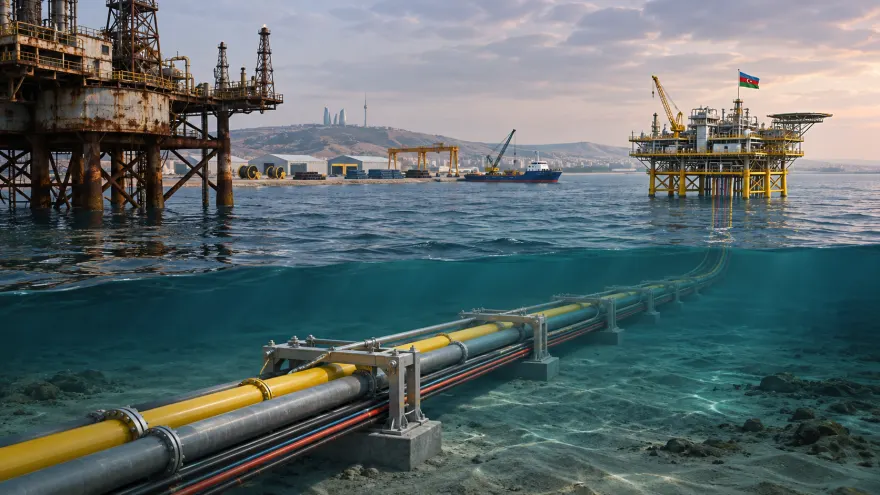
This proposed method, known as the “bundle,” would integrate oil/gas pipelines and electrical wires into one structure, made ashore in seven-kilometre sections, and then laid underwater. Repetition of this process may save on the cost and difficulties involved in laying individual pipelines underwater. However, it still needs to overcome technicalities associated with the design and installation process as well as procurement costs.
It is not only about Karabakh; the government of Azerbaijan, along with its partners, has spent decades building up massive oil reserves and a delivery system that would take the oil from Azerbaijan through Georgia into Türkiye. While the smaller oil fields might benefit from this existing infrastructure, they do not necessarily have the financial wherewithal to maintain the level of spending of their predecessors.
It is felt even at Azeri-Chirag-Gunashli (ACG), the field which made Azerbaijan into a large-scale exporter of crude. Its production average for the first nine months of 2026 stood at some 320,000 b/d versus 327,000 for the corresponding period in 2025. The output of national oil and condensate decreased 3.9 percent to 19.9 million tonnes during these nine months. Nothing points to an immediate end to production, although it shows how ageing fields can be maintained in their output through increased efforts and investment.
Since its start-up in 1997, ACG has produced some 4.7 billion barrels. For the January-September period of 2026, its operators invested $1.09 billion in capital expenditures. By the end of September, bp had some 154 producing oil wells, along with water and gas injection wells. A new development brought the gas reinjection capacity of the Central Azeri platform up by 20 per cent. Advanced seismic technologies, extended horizontal drilling, and improved reservoir management are key factors in squeezing more value out of the same seabed.
This is a quiet but subtle change in the age-old tale of exploration. It isn’t just the mature fields that are being milked to their last drop; they’re constantly being re-engineered. In the case of Azerbaijan, small innovations do make a difference, since they don’t have to build a completely new offshore infrastructure.
Second lifeline in gas
ACG also acquires another commercial profile. In June, bp initiated its production activities in relation to gas that is not associated with the oil that had been produced in the field before. The company sees approximately four trillion cubic feet of gas recoverable in the Gunashli region, with upside potential of six trillion. Early production wells are still within the scope of a test and appraisal program, while Aslanbayli confirms that development of the project is underway as planned and budgeted.
The idea is quite obvious: gas and condensate can be produced via existing infrastructure in ACG and Sangachal Terminal. This means lower expenses for commercialisation of additional resources. However, estimates of resources alone do not mean anything as far as production levels, investments in development, and sales commitments are concerned. The next step is to prove the reservoir capability at large scale. Let us take a look at the market incentive now: During the first nine months of 2026, Azerbaijan had a production of 37.9 billion cubic metres of gas, out of which 18.4 billion were exported, while 8.6 billion were shipped to Europe. The need for diversification by Europe is a key factor, but supply lines, contractual obligations, and future demand also matter in deciding what can be profitably marketed.
Capital is increasingly discriminating worldwide. The International Energy Agency expects energy investments of $3.4tn in 2026, of which $2.2tn will be spent on clean technologies, transmission and electrification, against $1.2tn spent on fossil fuels. Oil investments will amount to less than $500bn. Therefore, large-scale upstream projects have to compete not only with other oilfields but also with many energy projects.
The projects in the Azerbaijani portfolio of bp illustrate the situation. Besides gas and oil developments, bp is developing the Shafag 240MW solar project in Jabrayil and the $230mn Sangachal electrification project. According to bp, the combined projects would reduce the emissions of the terminal by about half and release gas, which otherwise powers the facility. In this example, decarbonization and hydrocarbon economics do not contradict each other: the better use of electricity leaves more gas to sell.
Despite any non-accumulated setbacks, financial incentives are still significant. Azerbaijan’s sovereign oil fund is valued at around $74bn as of the end of September, with the 2027 budget draft envisaging AZN11.9bn worth of oil fund transfers – 30 per cent of total state income. This financial buffer allows for selectivity and highlights the importance of the quality of future investments. Oil and gas revenues keep driving the development of the whole country.
The decision on Karabakh’s future for 2027 will, thus, put the country’s ability to make not only one but several offshore projects at stake. This will show whether Azerbaijan can go beyond the economics of large-scale hydrocarbons to the economics of smaller-scale but well-engineered projects and extend production of oil fields and build a new energy sector. The next success in the Caspian Sea may be measured not in the number of barrels discovered but in the value left by each of them.